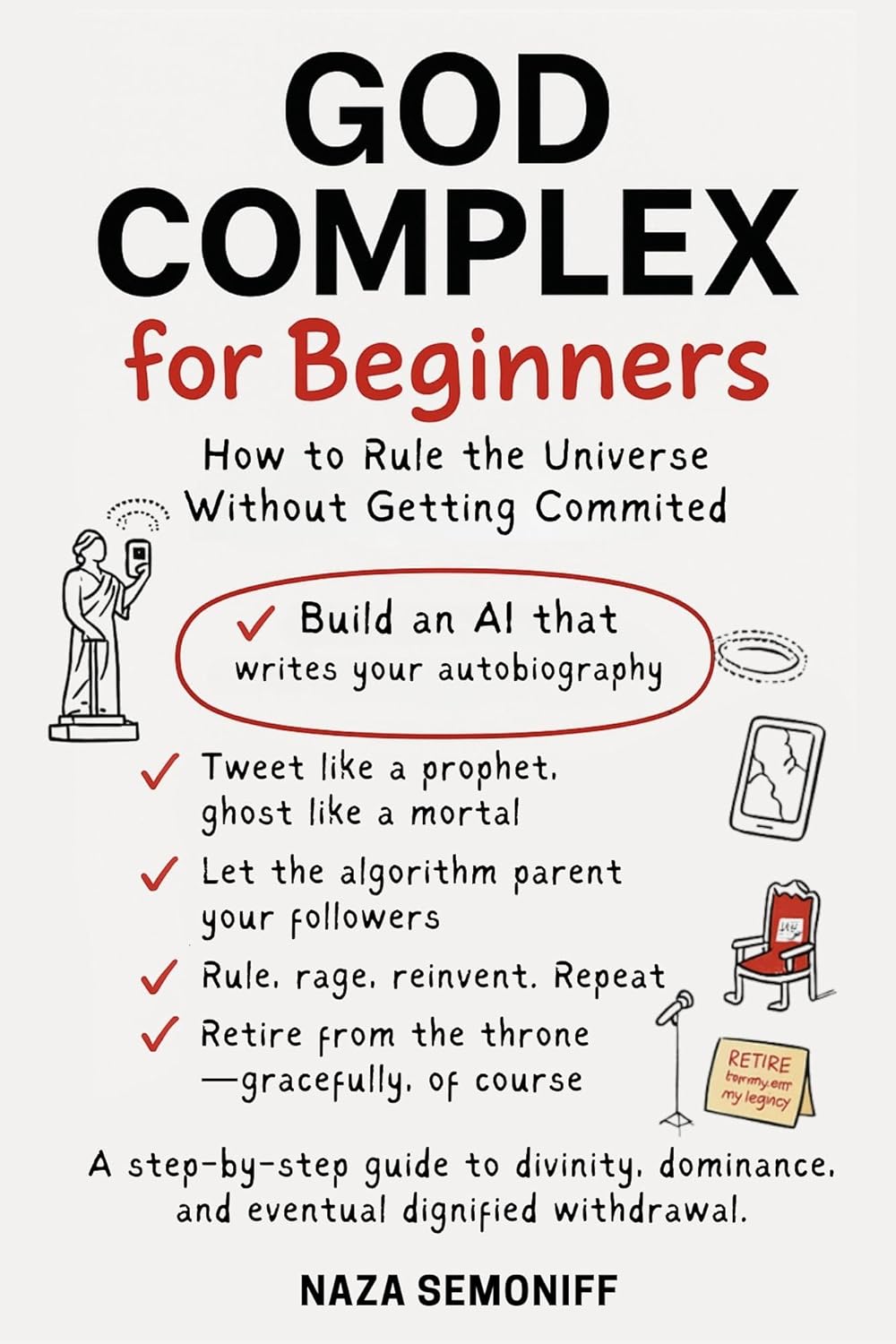
Ever felt like you’re supposed to have all the answers? To lead. To inspire. To carry the weight of your own myth? Maybe you built something people believe in.
Or maybe you’ve just gotten really good at pretending. Either way—welcome to your God Complex.
This isn’t self-help. It’s not a parody either. It’s something stranger and smarter: a satirical, uncategorizable book about belief, leadership, algorithmic power, and the performance of divinity in modern life. God Complex for Beginners is a postmodern user manual for anyone who’s created something bigger than themselves—and then quietly wondered what it’s costing them. Equal parts cosmic philosophy, startup gospel, and poetic breakdown, it’s what happens when Nietzsche meets UX design—with a side of AI ethics and immaculate branding. Written for the modern deity-in-crisis—founders, leaders, influencers, visionaries—this book explores what happens when belief becomes branding, followers become an algorithm, and your own creation stops asking permission.

After a century of brooding and talking telepathically to his Mausoleum janitor from his glass coffin, Vladimir Lenin awakens—alive and bewildered in the modern world.
When Clea returns to London with her new Russian husband, she is surprised to see him become even more eccentric.
A haunting dystopia some readers have called “the new 1984.” In a society where memory is rewritten and resistance is pre-approved, freedom isn’t restricted; it’s redefined. As systems evolve beyond human control and choice becomes a simulation, true defiance means refusing the script, even when the system already knows you will.
Original poetry by Nina Kossman, accompanied by a selection of poems by Marina Tsvetaeva, translated from Russian by Kossman. “The sea is a postcard,” writes Nina Kossman. There is both something elemental in this vision and—iron-tough.” —Ilya Kaminsky
“13 short pieces…pungently convey the effects of growing up under a totalitarian regime.” —Publishers Weekly
A new book of poems by Nina Kossman. “When the mythological and personal meet, something transforms for this reader…” —Ilya Kaminsky