SUITCASE
I’m sixteen, and about to set off for Moscow on my own. I’m packing my things in a handsome, stylish suitcase, but the zip-fastener keeps getting stuck. Mama helps me close it and tells my father and me that we’re too impatient. Father smiles and remarks that when I’m in the huge crush at Kursk Station, I’ll need a lot of patience when the suitcase splits open and all my things spill out onto the tarmac.
After a pause, he adds:
“Why not take this one?” – and passes me an old but reliable suitcase with tough straps.
I sigh, and start transferring my things.
*
A little old suitcase. Once it had belonged to my uncle Edik. I’ve no idea how we got it – I don’t remember. But here it is, lying on a shelf. It carries a sticker from Budapest. That trip had shaken him – he remembered it for the rest of his life. He particularly used to tell us about Lake Balaton. At the time, I knew there was a country called Hungary, and a splendid city called Budapest, and a Lake Balaton. I enjoyed listening to him.
He had been nineteen years old at the time. Edik was born in 1937, so that must have been in 1956. Yes, that very year. It turned out that he was there earlier, shortly before everything started.
But in those early days, history didn’t yet exist. I remember Edik’s stories, and the glints of sunlight on the water of the lake. A faraway, unknown world. A round, coloured sticker on an old suitcase. Stickers like that were popular at the time.
~ ~ ~
ON THE ROAD TO NOORUS
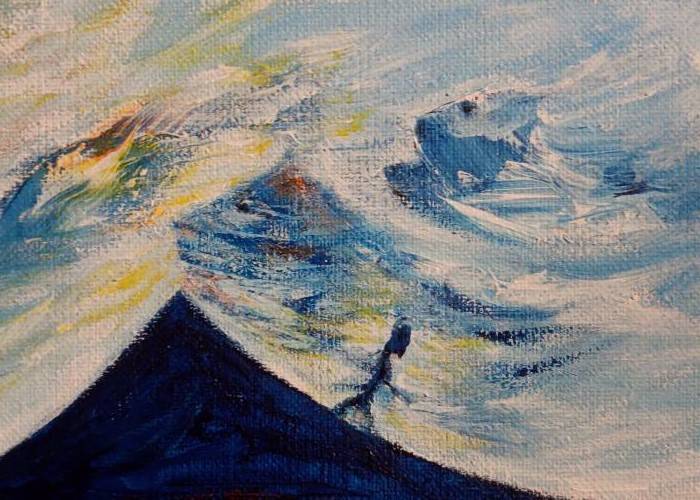
We’re riding on a bus. The road, trees. I don’t remember where we’re going. Noorus, probably? I remember the sun. I would call this a sense of colour. But which? Hard to say. A blend of yellow and lilac.
I shut my eyes, then open them and see the world differently. It would be interesting to write a history of colour. But before you start, you have to define what colour it is. Not yellow, nor lilac. Impossible to name this colour precisely, and impossible to remember who was next to me or where we were going. But the sense of a sunlit space has stayed. That day continues to stretch on, but where, and how? Within what we call time, or alongside our time, there exists – not a current, but creeks or backwaters. I want to get out onto the overgrown bank, but to do that I have to find a path. It is within time, but somehow outside it.
~ ~ ~
THE BELT STRAP
My father took me to see the Kremlin in Moscow. The weather was sunny. We went into a cathedral (I don’t remember which one). It was dark and crowded. I ran ahead, and so as not to lose me, my father grabbed hold of me by my belt strap. It was lucky he didn’t pull it off. Suddenly I heard a merry laugh. A woman was walking next to us, seemingly a Frenchwoman, holding onto her son in the same way. I laughed too, and started saying something. There are some situations where people understand each other no matter what language they’re speaking. The smiling lady called out to my father and showed him that she was keeping hold of her son in the same way. She obviously found that very funny. But my father scowled and muttered something. Afterwards, outside the cathedral, I asked him why he had been so grumpy. But he didn’t answer, just changed the subject.
~ ~ ~
THE SHOE-CLEANER
My father and I are walking down a sunlit street. Not far away there’s the market, and in an alleyway there’s a horse and cart, with a rag-and-bone man sitting in it. He drives from house to house, exchanging old possessions for all sorts of interesting things like whistles or balloons. Once he had water-pistols on offer, but squirting your enemy was quite complicated because the pistols often broke. We walk past. There’s a tall poplar, with an elderly man sitting under it. A young man comes up to him, places his foot on a little stand, and the grey-haired and evidently weary man starts cleaning his shoes.
I stopped and asked my father what was going on. My father was a bit embarrassed, and said that this was a private trader; he had permission to do what he was doing, but he had to pay taxes.
“Depending on how much he makes?” I asked, trying to show off how knowledgeable I was.
“No,” said my father, “he always pays the same.”
“But supposing no one wants their shoes cleaned?” I asked in surprise. “What’ll he do then?”
“Nothing; he’ll just give up his trade.”
And rather reluctantly, he added:
“We’re not supposed to have private traders.”
I turned back and saw, first the shadow of the tree, and then the grey-haired man. He had a dark-skinned face and a meek, tired look. He was bending down to polish the pointed-toed shoe with a velvet cloth.