













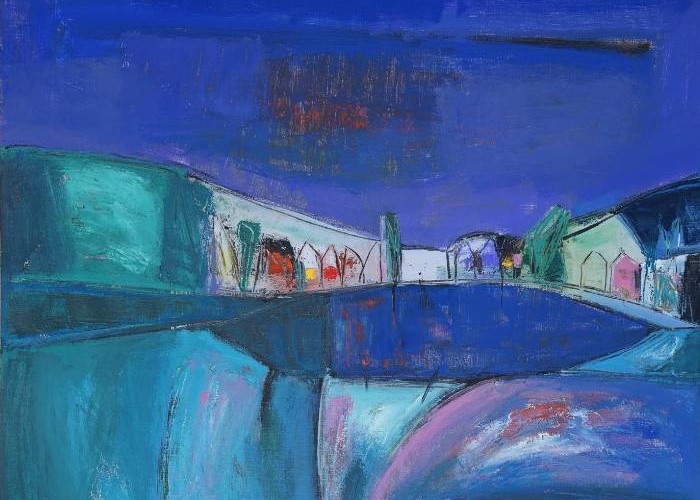
Night has fallen
lights are lit
oil dreams keep
my visions in glass lamps
and I walk in the darkness
and every bush and every leaf
everything whispers to me
Listen, Hamlet! I have lived my life in vain. I can’t even say what I wanted. I don’t remember. What was I striving for? I remember there were many lines, doors, I always needed some kind of certificate, I was always calling someone, I was always late, I was often fired… That’s right — I was often fired, I was slow and out of place, I couldn’t fit in, even in the smoking room or, say, at gatherings, I felt like a spare part, and I was bored all the time… and dreamed… About what? Very simple. I dreamed of seeing my book on a shelf. This dream burst into me like a crystal comet, it confused everything, it didn’t let me live. Because this is not life — your head is clouded, your heart beats unevenly. Dear Hamlet, words steal feelings, replace life, take away the sweetness of love, the intoxication of wine; if you write, you don’t live — you watch everything, yourself first and foremost, you study yourself, with every page you write, with every line, a magnifying glass grows inside you, it crawls along the walls of your cave, peering into every crack. You no longer trust anyone, you painfully watch over your luggage and scratch out words from your manuscript if they are suddenly used by scribes. Structures grew inside me. Parts of one large system (everything is interconnected, and there are holes, gaps, and cracks everywhere). I was so absorbed in studying the intertwining of meanings, searching for knots in the web — I walked with a rope, dived into wells, crawled through cave passages, gave myself completely and understood nothing in life. Not even Schopenhauer. I was wrong about everything. And how I loved him, how I read him! And I loved Kierkegaard even more. I carried Fear and Trembling under my jacket, hid it from the rain, from prying eyes, sitting on benches, it was always with me. And what did I understand? I take it off the shelf, look into the same book—and understand nothing; I remember, I recognize, but I don’t understand, I ask myself: what was it that fascinated me so much back then? What scared me so much about him? Why did he say there was nowhere else to go?
I lived by my emotions… and was punished for it. In this day and age, you can’t be so careless. You can’t let your guard down. It’s easy to say – try to follow this rule, pull yourself together! If only I could! I’ve always been bad at discipline. How stupid – but how fair! Life is remarkably fair. When you realize this, it becomes even more frightening. I used to think that I lived apart from life. Unbelievable, right? I imagined that life was rolling along on its own, that it was passing by somewhere on the side, as if I were walking along a highway where trucks and buses were carrying this very life, and it was not happening to me — except for those moments when I got on the bus or climbed (my grandfather helped me) into the cab of a truck:
Grandpa drove an old GAZ, and we also had a very old Moskvitch, humpbacked, with a gear stick by the steering wheel and a covered wheel at the back (our car reminded me of a cocker spaniel). It’s strange that I remember all this. It’s a dump. Rubbish, rubble, sand… it’s long past time to forget. I’m drowning in it.
So, life rolled by without me. It can be misunderstood. What does “separate from life” mean? As if there is me, and there is some kind of train of life. Here I am, sitting with a book on my bed, my legs tucked under me, a blanket over my shoulders, a lamp shining from the table above my head, papers, pencils, and pens lying on a chair next to the bed — everything at hand, I took it, wrote it down, caught the thought, and at this time the train of life is going around in circles somewhere out there, and I can get up, stretch, yawn, slowly put on my silly green pants, fasten my belt, pull on a flannel shirt, throw on an old Danish jacket that min danske onkel sent me (let’s say it’s 1993, the year I read Kierkegaard the most), and I’ll go to the tram stop, get on the tram, and life will resume. How naive! But I knew how to stop time by reading: I opened a book, and time stood still. But it turned out to be not like that at all. Time doesn’t stop, life isn’t a train, it seeps into every pore, it’s everywhere, in every breath you take, wherever you hide, it will be with you, beating in your pulse. You read a book, and life reads you, guiding your feet along the line to the precipice. You sit in parentheses, the editor’s gaze approaching you. They take you out, stretch you out, study you with a magnifying glass — aha, they give you another chapter, another, you run, become a rogue, a nimble mouse darting into the third chapter, springing up like a bird, fluttering out of the cage, walking again along the line of life with dignity, riding the tram, standing behind the lectern, signing author’s copies, nimble mouse. The more you delve into the structure of the universal mechanism (I look at myself more closely than ever, because the universe is me too), the less hope this indifferent mass leaves. There is not the slightest hope of understanding anything. Confusion and absurdity. A smokescreen of chaos. Nonsense, fog, blizzard. Why can’t I wake up on the other side — where legs grow, where the dead are buried? I still haven’t found the right words to convey my sense of confusion. Words fail us… I could express myself differently here: scratch a pebble against the iron lid of a container, but now there are no such containers; I could tap a nail head with a hammer, but there is no hammer, and all the nails are rusty. The Music Improvisation Company provided all sorts of sounds — I put on a record, and that’s all I have at hand: a record, a needle, dust on a velvet pad; I listen, I listen carefully, I strain my ear painfully… Confusion and absurdity. That’s why I can’t find the words. But this mass cannot be meaningless! It can’t be! If there is meaning in these scratchy and cutting sounds (I intuitively feel them, I grasp the structure, without me there would be no meaning in them!), then infinity must also have some kind of structure, even if it is incomprehensible to the human mind, but there must still be consciousness in it: otherwise I would not exist!
Nowadays, people mostly do not hear each other, everyone shouts their own thing (like at a prison visit in an old forgotten novel); if a person is silent, it is clear that they are preoccupied with their own thoughts, a whole swarm of thoughts: there is so much to do! What is the point of taking on a task if you cannot see it through to the end? There is so much to do… He shouts inside, he knows no peace, no silence. And here he is in front of me, paralyzed by procrastination, unable to take a step, not knowing whether to offer me his hand or not. His name is Eric, he is a pyrotechnician, we have known each other for twenty years, we’ve traveled half of Europe together, and now he looks at me with a numb gaze, as if seeing me for the first time, his mouth plastered with news reports, his hands shaking for some reason, he can’t even explain it because he’s confused about himself. In short, we caught the man off guard when he was swamped with his thoughts, walking around the apartment in his coat like a beekeeper in a mask, solving some complex problems. We were not welcome. Because we were invited by his wife, whom he has been leaving for ten years (and will never leave, in my opinion). When he saw me, he was taken aback, said he had a lot to do, fidgeted and ran out onto the balcony, where he stood with a cigarette and a glass of wine, all tense, in a state of numbness characteristic of our times, looking at the sky, smoking, as evening fell; I asked to stand next to him, without wine or cigarettes:
“I quit.”
He was surprised:
“You?”
“I’m surprised myself. It seems that this time it’s final.”
“And I went to the Antilles.”
“You made your dream come true.”
“Yes.”
“Well done!”
However, I saw the photos his wife sent, my wife showed them to me — we communicate in a strange way. They got divorced, he’s trying to move out, but he can’t because all his money goes to traveling, and then he needs to rest somewhere because traveling isn’t easy; We heard rumors that on his last trip to Africa, he caught a subcutaneous worm (Mansonella streptocerca) and cut out the larvae himself. A horrible story — and he has so many stories like that… He himself has long been a participant in the story I wrote and published, but he has no idea that he lives in a novel (we all live in a novel, or better yet, in a fairy tale: that’s how the human mind works, we create villains as long as our consciousness is split into good and evil).
We stood on the balcony, he quickly drank his wine and smoked slowly, while I sipped my tea; outside the window was a very sad view: a dirty wasteland, prefabricated buildings in the distance, and in the darkness, if you looked closely, you could see the outlines of an old market, its concrete piles, an arch (the market’s gates resemble Auschwitz). But that’s not why Eric is running away from here. Escape is in his blood. Searching, adventure, adrenaline… He’s from the countryside, from a match factory, now he has his own business and a large apartment overlooking the market and the wasteland, but his soul needs something, he is constantly drawn to the road, he loves to visit gloomy places, abandoned houses, haunted castles…
I don’t travel anymore, I can barely drag my feet, I barely have enough strength to go to a concert of my favorite band, I can’t imagine myself in a tent. He is an avid fisherman, and I feel sick when I see a raincoat and high boots, my prostate starts to ache…
But he likes it — he says it’s great, he caught some fish, built a fire, and immediately roasted them in foil on the coals… He talks, and I remember how my father and I went hunting once. He was in his suit, with a double-barreled shotgun on his shoulder. he gave me an old small-caliber rifle, the barrel was slightly bent, we shot at a can, I never hit it, and then he saw a seagull in the air and said, “Shoot it!” He thought I wouldn’t hit it—I thought so too—but when I fired, I hit it. It didn’t fall, so I decided I had missed, but suddenly he said, “Wait a minute…” The seagull glided strangely onto a stump, stood there and cried silently, opening its beak without making a sound, and did not fly away, even when we approached it, it did not take off… and my father said: “You hit it!” And I felt scared and hurt, I looked at the seagull, and I was pierced by a feeling of pity for her, mixed with a strong feeling of pity for her and annoyance at myself: why did I shoot, why?.. She’s dying, and I can’t help her anymore! Later, I often remembered how it opened its beak, crying out helplessly; if I suffered for something, if some misfortune befell me, I thought of the seagull, remembered it standing on a stump, silently opening its beak… and thought: this is why life is punishing me! Nonsense, of course, I grew out of it, as it were, and I don’t believe in karma. Much has changed in me over the years, I have come to look at life differently, all religiosity has fallen away from me, any punishment is a new crime, because it does not exist in nature, etc. In short, I have long had different views, but I don’t forget that incident, I often remember the seagull on the stump. I believe in the bond between father and son, I believe that this bond can do a lot for a person. Sometimes I say something to my little boy and I dislike myself for it, because I understand that he takes every word I say, even the most simple and thoughtless ones, to heart, even if he doesn’t want to. I dislike the importance my words have for him, even if he takes what I say with hostility. I was afraid of my father; he was not a hero to me. I saw him in a terrible state, I heard him raping my mother, coercing her, I heard him swearing and cursing everything in the world—and yet he influenced me, I noticed it, I resisted the nature of this connection.
A father tells his son to “shoot!” and the son shoots; then the state says “shoot!” and the soldier shoots—I believe that; the father establishes a person’s relationship with society, the father makes his son a soldier who, without thinking twice about the order, will fire a Buk missile and bring down a plane, or press a button and launch a rocket that will hit a building with more than two hundred residents. This is happening every day, every day… and it is impossible not to think about it. I know this and cannot hide it from myself; a seagull screams inside me, killed by me many, many years ago, forty years ago it was, and it screams in my heart. I no longer hunted with my father or went fishing with him, I questioned every authority, I always doubted everything and was dissatisfied with any government, I was not and will not be a patriot: every state uses people — you need to know that! Remember, man, that when you become a citizen, you make a compromise—not the state, but you make a compromise. Every state uses people in its own way. The only problem is that over time, countries change, governments change, bosses change—they all change: today they say one thing, you agree with them, and tomorrow they will say something you cannot agree with, but there will be nowhere to go, you will be bound by oaths, obligations, loans, children, and so on.
Doubts suck the blood out of me like leeches: here’s the leech of discontent, here’s the leech of mistrust, here’s the leech of fear…
“What, do you think I’m happy with our government?” Eric asked defiantly and suddenly. I didn’t have time to answer, he pressed on: “Do you think I vote for the Conservatives? Do you think I like the fact that our prime minister’s husband has business interests in Russia?”
“I don’t think anything.”
“I can see what you’re thinking!”
“I don’t care.”
“I don’t believe you.”
“Whatever you say.”
Of course, he was right, but I wasn’t going to argue. That wasn’t why I came out onto the balcony. I just wanted to stand there quietly, looking into the darkness; I was tired of explaining myself — who do I owe any explanations to? I was tired of all this chatter, I needed to figure myself out, to answer some clear questions: what next? Who do I see myself as these days? Where to now? Now: it’s witch-hunting season, totalitarian winter is getting stronger, the country is covered in ice, I’m trying to keep my mouth shut more and more, our little one is talking about moving to Canada, Lena’s parents are very old:
“If you want to go, go,” she says with a half-joking resentment in her voice, knowing full well that without her we can’t go anywhere, “and I’ll stay with them.” On top of that, there are dreams in which I am haunted by rats (rats running through the empty halls of the Louvre: I am not there either, I am an active video surveillance system, CCTV, recording in my dream the movements of a flock of rats through the halls). I think too much—and I think about what my son’s life will be like in this godforsaken world. I’ve lived my life: my case is officially closed. How will the kid live?! That’s my main question—my head throbs at night, I get up and think: how can I live out the rest of my days to save him? How can I be useful now in a future where I am no longer there? Under the pressure of nighttime questioning, I begin to get confused and delirious: maybe there’s nothing wrong with humanity disappearing? Don’t people—me, and us together with him—deserve to disappear? Let it disappear completely! And with it, torture, wars, camps, cells, prisons… the memory of all the horrors that people have committed. Let the rats run around the empty halls of the Louvre! Such thoughts shake me like a fever, and they make my mind even more restless; surprisingly, they calm me down: I lie under the blanket, cold with sweat, unable to warm up, shivering, but I calm down and fall into a feverish sleep: circles, images, butterflies, snakes dance before my eyes, everything shimmers like a psychotropic kaleidoscope, and I, a lost piece of glass, spin in random clusters of glass pieces—endless variations. Night after night, the torture resumes: the same tormentor, the same questions… In the darkness, I see a road and a bridge over it. In my vision, it is much darker and longer than in reality. Instead of streetlights, there are pillars, and there are also pedestals with gargoyles, jellyfish, harpies, demons, diseases… here is Slavery, here is War, a huge column of Famine, statues of martyrs, statues of hermits, fugitives, beggars, madmen, cripples, drug addicts… All the horrors, ugliness, and disfigurement that can be imagined: sins and torments climb onto pedestals, stand up and freeze, beautiful, impressive, terrifying… I approach the edge, look down, and instead of Laagna tee, I see some kind of Japanese autobahn with large trucks rushing along it: a completely impersonal mechanical movement, probably without a human behind the wheel, a steel stream, a stream of rapidly moving dead structures—fragments of this ugly world that Jack built. I throw myself down and fly for a long time toward the fast-moving stream. The night splits apart…
________________________________________
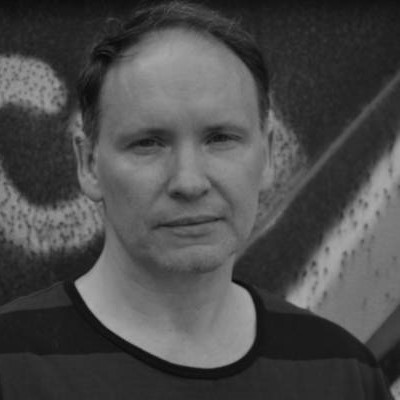
Excerpt from Andrei Ivanov’s “Night” (New Review, No. 315, 2024) “The Time of the Hourglass” (Avenarius, Tallinn 2025)
Translated from the Russian by N.K.
“A book should serve as the ax for the frozen sea within us.” (Kafka)
A new collection of poems by Andrey Gritsman. In English.
The new poetry collection from Wayne Pernu, one of the finest poets writing in English today. This is one of those rare collections that calls to mind the great masters—Donne, Keats, Yeats.

Comedy and tragedy collide in stories of family life in Soviet Russia and the complexities of the immigrant experience