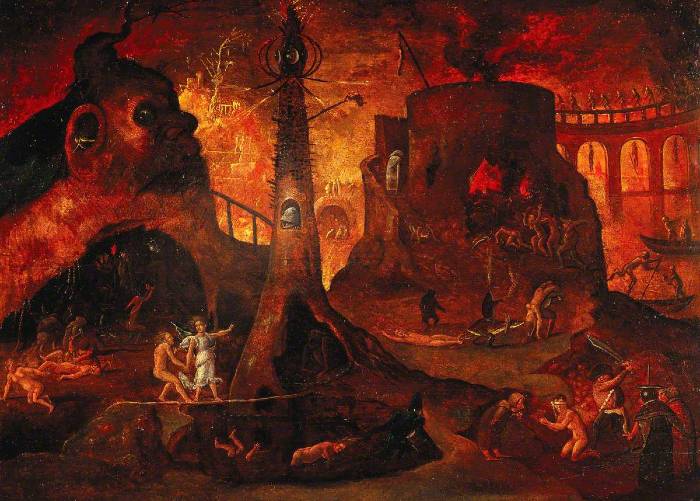
The Ayatollah ended up in hell, where he was greeted with the question: “Who are you, and why have you come here?”
The Ayatollah hesitated. “What do you mean, ‘Who are you?’ I am the great Ayatollah! The highest authority in Iran!”
The clerk at the gates of hell said to him, “You’re no Ayatollah. You’re a fool, as plain as day. In your next life, you’ll be reborn as a little girl. As soon as you turn nine, you’ll be married off to an old man the same age you were when you died.”
“You’ve got it all wrong. How can I, an old man, be a girl? And anyway…what’s going on here? Where am I? There’s no reincarnation. We are given one life, and when we die, depending on how we lived and how we died, we go to paradise or hell. And I, of course, deserve to rest in paradise after all that hell on earth. I had to execute so many people—you wouldn’t believe how exhausted I am.”
“I believe you, I believe you!” replied the clerk—the very one who had decided that the old man would be best suited to become a little girl in his next incarnation. “It’s not just your hands that are covered in blood; blood is dripping from your nose!”
The Ayatollah brought his hand to his nose—and sure enough, it was dripping! He wiped his nose with his hand, but the dripping continued. And so the Ayatollah stood at the clerk’s desk on the edge of hell, which, in fact, was not so different from an office on earth, and sniffled. He stood there, sniffling, wiping his nose with his hand, with no handkerchief, sniffling again and wiping again. And the blood kept dripping and dripping, but it wasn’t his blood—it was the blood of innocent Iranians executed on his orders. Now the Ayatollah himself was beginning to understand something about this endless dripping blood.
“Is everything clear now? Any questions? In the future, direct all your questions to your master—that is, your husband—because as soon as you turn nine, you’ll be married off. Do not disobey your husband! Respect the old man, please him in everything, do not refuse his caresses. You’ll be the most charming girl; he won’t be able to keep his hands off you. This, so to speak, is the gist of it. You’ll learn the rest once you get there.”
The Ayatollah stood there, his head bowed, repeating quietly, as if not believing what he had heard: “Don’t refuse his caresses? Are you saying this to me, the great Ayatollah? ‘Obey him in everything?’ Who ‘him’?”
“Your master. Your husband. I’ve wasted too much time on you. It’s time for you to go.”
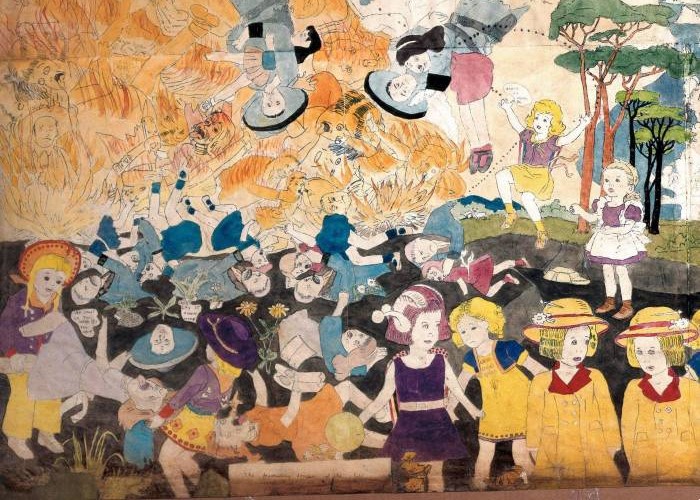
He took a bell from the table and rang it, and then something strange began to happen. Was it a whirlwind? No, it was not a whirlwind. Perhaps a blizzard? No, it was not a blizzard either. As soon as the Ayatollah felt himself rising into the air, he was released. It was a pity, he thought, that this state of weightlessness between the two worlds had lasted so briefly. He tried to remember the word that the clerk had used in the conversation about reincarnation but couldn’t, because he had become a little girl who didn’t know long, unnecessary words; who knew only that tomorrow, after what adults call a “wedding,” she would be allowed to take her favorite doll and her equally beloved teddy bear to the house of an old man whom her parents had told her to honor and love and whose whims she had been told to obey unquestioningly.
This girl’s name was Atola. She did not remember her previous life, in which for many years she had played the unenviable role of a bloodthirsty tyrant hated by all. With one hand she held her favorite doll close to her, with the other her teddy bear, and wondered if her “master” would allow her to take the doll and the teddy bear to bed with her—after all, she had always slept hugging her bear and her doll. And why was the word “bed” mentioned when grownups talked about the wedding and her future life in the old man’s house? There was some connection between these words—“bed” and “wedding,” but the girl didn’t know what it was.