I was born on October 10, 1953, and died on October 7, 2023, just three days shy of my 70th birthday. The circumstances of my death were unusual: I was killed by Hamas militants who broke into our kibbutz Be’eri early in the morning on Saturday, October 7. At the time, I thought my death was pretty pointless, that it served no purpose. But, on the other hand, there has to be something pointless in our lives, otherwise life would be too perfect, which is simply not possible.
I often thought about what happens after death: either a person ends up in a pitch-black wilderness, where they experience loneliness and boredom, or there is complete chaos there, with people walking the streets and sitting in bars, and some flying in the sky, scaring helpless birds.
In fact, after-death reality turned out to be similar to the life we know: the same buildings and streets, people seem ordinary, only no one is in a hurry because we have unlimited time. If you didn’t have time to do something today, you can do it tomorrow, or in a month, or in a year — if, of course, it still makes sense to do it.
I met Mahmoud eight days after my death. My relatives and friends had just finished sitting Shiva (the traditional seven-day mourning period) for my untimely departure. I think they said a lot of good things about me during Shiva, almost as much as they would have said during my 70th birthday celebration. So I managed to get my share of compliments, and it doesn’t matter whether it was during my lifetime or after…
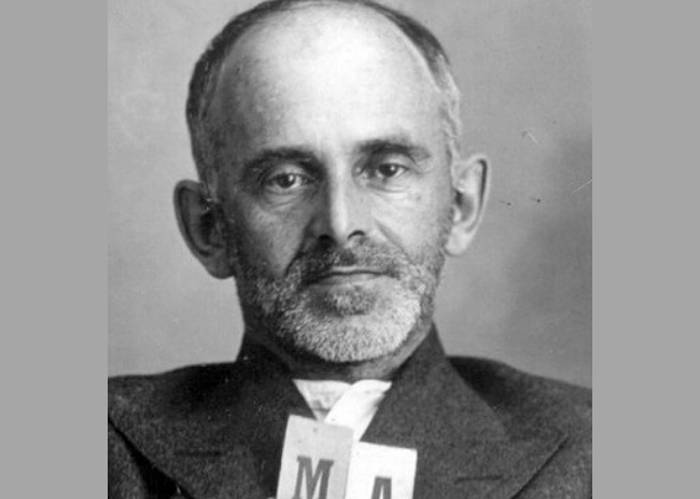
The conversation with Mahmoud came up at his cousin’s birthday party. The lunch was held at a fancy hotel, and I ended up there quite by accident. A guy I started working with a couple of days ago at an Arab restaurant invited me. People there are not too formal, and you can go to parties and various celebrations even without an invitation. No one is surprised or turns up their nose. Mahmoud and I ended up sitting next to each other at the same table. We introduced ourselves and struck up a leisurely conversation. To be honest, I didn’t find him particularly attractive. He was neither tall nor short, with a medium-length haircut, dark skin, prominent cheekbones, and a sparse beard covering his entire face. There was a small scar on his right temple, proof of how he got here. His eyes were strange, darting from side to side, but to be honest, everyone here has strange eyes, unlike in that life. There was nothing remarkable about his appearance, but there were no obvious flaws either, and we quickly struck up a conversation. Probably because I never liked excess, whatever form it took — good or bad.
During my eight days here, I decided that I liked the inhabitants of this reality.
They were no longer afraid of anything, they didn’t make empty promises, they weren’t noisy, but they didn’t follow a strict regime either, they weren’t ambitious or sycophantic, they weren’t petty or jealous, and most importantly, they were all equal because they were all dead. Perhaps over time I will change my opinion of my neighbors; perhaps it is not worth making such profound, philosophical generalizations so quickly. However, the beauty of it is that there, you are allowed to make mistakes, and no one will judge you for it.
But let’s get back to our conversation with Mahmoud. It turned out, by a strange coincidence, that he had also arrived there eight days ago. Mahmoud slowly recounted his difficult childhood in Jenin, a city located in the Palestinian National Authority province, not far from the Israeli border. Jenin was heavily influenced by Hamas, and Mahmoud listened eagerly to their moralizing. He was the eldest son in a family of twelve brothers and sisters, and at the age of ten he began working with his father in a small workshop repairing shoes and clothes. I, in turn, shared the story of my life on the kibbutz, how I worked in the fields, milked cows, and worked on a poultry farm since childhood. I also talked about how we helped Arab families from the Gaza Strip, especially when urgent medical care was needed. Most of the residents of our kibbutz were supporters of the creation and peaceful coexistence of two states—the Palestinian state and the state of Israel. Every New Year, we collected money to help the people of Gaza. Mahmoud listened attentively, nodding his head from time to time to show his understanding. Then he suddenly asked:
“I understand that your life has turned out quite well. How did you end up here?”
I already knew that it was not customary to tell outsiders about the circumstances that brought us there, but suddenly I wanted to answer his question in detail, as if someone inside me was pushing me to disregard the rules accepted there.
“On October 7, at half past six in the morning, we were awakened by sirens warning of a rocket attack on the kibbutz. Immediately after that, we heard rocket explosions. My wife and I woke up our sleeping grandchildren and, still half asleep, went into the security room next to our bedroom,” I said quietly, glancing at Mahmoud. He remained completely motionless, only his gaze continued to dart from side to side.
“Our grandchildren came to visit us a week ago because their parents went on a trip to Italy for the Jewish holiday of Sukkot. Sixteen-year-old Michael was two years older than his sister Dana and had a handsome, masculine figure since his teenage years, with a slim waist, long, strong legs, and broad shoulders. His dark blond curly hair framed his tanned face beautifully, and his flawless nose gave his face a biblical beauty that drove most of his classmates crazy. Dana, his sister, could not be called a beauty in the usual sense. She was short, with full lips, a wide mouth, and a small snub nose. Yet there was something special about her that attracted the hearts of boys. It was enough to look into her eyes—there, in the depths, reflected the sparkle of recklessness and a strong character capable of unexpected and decisive actions. I was describing my grandchildren to a complete stranger, which surprised me greatly. In our family, it is not customary to boast, and I don’t know what came over me—perhaps I had already managed to shake off my usual modesty. I can’t say why, but I really wanted to describe my grandsons in this way, specifically to Mahmoud.
Fifteen minutes after the attack began, messages poured into the kibbutz group chat about the sounds of gunfire and Arabic speech that residents heard outside. Then came the terrible messages from different families:
“My father and mother were shot. Help, help!”
“They’re throwing grenades, they blew up the bomb shelter, the Palestinians are burning houses.”
“Our neighbors were burned alive, the children were put on motorcycles and taken away somewhere.”
“We can see everything from the window, they are raping girls, then cutting them alive, dismembering their bodies.”
“Anat resisted, so they cut off her head with a shovel.”
“They are in our house, they rolled a burning wheel inside, we are suffocating, they are shooting indiscriminately. That’s it, God save us.”
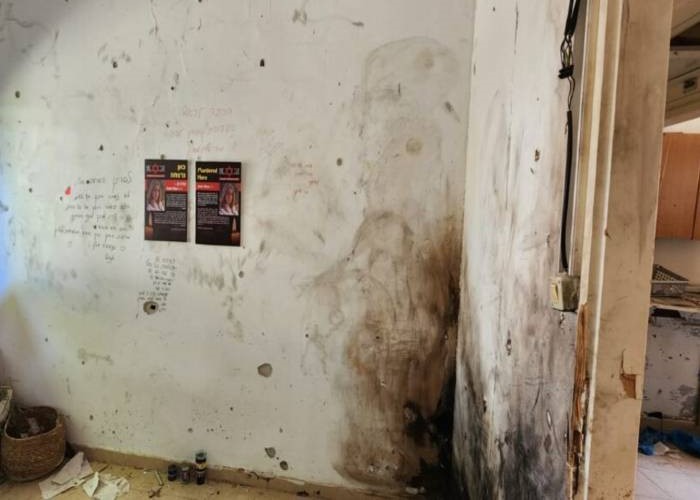
We sat frozen in the safe room. Our house is deep inside the kibbutz, and for a while we didn’t hear any Arabic spoken nearby. Bella, my wife, hugged Dana and prayed quietly. Michael sat in the corner, holding an axe in his hands, his eyes showing no fear, his furrowed brow betraying his inner tension and determination to fight to the end. I held my pistol in my hands, the only firearm we had in the house. Then there were frequent shots and shouts in Arabic near the house. Through our home surveillance cameras, I saw on my cell phone screen four armed terrorists entering the house, opening closet doors, and turning everything upside down in search of valuable loot. One of them shoots at the doors of the rooms, then opens the doors to check if anyone is hiding there. Then he approaches the security room. I signal that we should lie flat on the floor, Bella lies down on Dana, covering her with her body. Michael stands behind the door with an axe at the ready. The Arab comes almost right up to the door and fires a long burst at belly level. It turns out that our beautiful security room can withstand rocket explosions near the house, but its door is vulnerable and lets machine-gun fire through. The terrorist tries to open the door, but it won’t budge because I blocked the door handle with a steel pipe beforehand. Then he shoots again and again around the perimeter of the door, and I hear Bella screaming, and my stomach burns as if devils lit a hellish fire there. My hands weaken, the gun falls to the floor, and with my last ounce of strength, I manage to shout to my grandchildren, “Pretend to be dead if they come in.” Out of the corner of my eye, I see Dana get to her feet, grab my gun, fire several shots at the door, and then shoot herself in the temple. “What are you doing, my girl?” is the last thought that flashes through my mind, mixed with a sudden warm feeling of pride in her — well done, granddaughter, you don’t give up alive.
“That’s it, the three of us, Bella, Dana, and I flew away, and Michael probably pretended to be dead and stayed alive, because he’s not here,” I finished my short story and looked at Mahmoud.
During my story, Mahmoud’s face was covered with red spots.
“As I understand it,” Mahmoud said with difficulty, “the Jews seized Palestinian lands many years ago. Didn’t you think that one fine day we would come and liberate them? Or am I wrong?”
I was taken aback by his words, then took a breath and replied:
“So you want to reclaim your land? Fine, war it is, but you can also fight by the rules. Why did you attack the peaceful population, rape, torture, and burn alive old people, women, and children, the very ones who dreamed of peace with you, who helped you in difficult times? Will that give you back your land? Don’t you feel sorry for these innocent people?
Mahmoud paused, then said, looking at his palms, “I don’t feel sorry for you, you are infidels, there is sickness in your hearts. This is Allah’s punishment, and a painful punishment for your lies!”
I got up from the table, not wanting to talk to Mahmoud anymore. Then I turned around and walked away from him.
Mahmoud also jumped to his feet, followed me, and whispered quietly in my ear: “After we blew up the doors of your security room with a grenade launcher, I went into the room to check if there were any Jews left alive. The room was filled with smoke, no one was moving, and I turned to leave the room. At that moment, someone shot me right in the head. As I fell, I saw him jump out of the window.”