It has been a long time since the Black Hundreds, the concentration camps, and the gas chambers. Even rootless cosmopolitans and murderers in white coats had somehow been forgotten. The fact that the Jewish quota had replaced the tsarist law on the Pale of Settlement was, of course, annoying, oppressive, and unnerving. Still, it did not instill any special fear in those living under the norm, nor did it make them tremble, and life went on, on the whole, in an ordinary way.
1
Collective experience and reason, despite everything, told them that circumstances could change rapidly and irreversibly, and that only those who were out of sight, those who did not attract the attention of the two-legged herd, would survive. therefore, under any circumstances, one must try to be indistinguishable in a crowd, or even better, try to become completely invisible.
Three generations of women who had lost their precious men and many, many loved ones in the turmoil of the century were now, with all their feeble strength, protecting their only hope for the future: they tried to raise their daughter, granddaughter, and great-granddaughter to be so inconspicuous that sometimes (until a certain point) they themselves doubted the reality of Anya’s existence.
At their insistence, the girl did not even reveal her full potential at school. However, Anya was naturally gifted, diligent, and hardworking, so she never got a failing grade. No, she did not possess any genius abilities, but her lively and meticulous mind, combined with diligence and perseverance, yielded very good results.
Nevertheless, the qualities of a gray, withdrawn, quiet mouse worked perfectly, and if her classmates had been asked one day how Anya studied and what she was like, most of them would hardly have been able to give a clear answer.
Only once, after long and difficult doubts at home, did they decide to break out of their gray shell for a moment, but in a terrible panic, they pulled their impenetrable house back over their heads. To the joy of the family, everything was quickly and happily forgotten.
And so it happened that on New Year’s Eve, their eighth-grade class was invited… to the theater! To see Cinderella. Anya had never been to such a grand performance before. Well, there was the matinee at kindergarten, and the provincial theater somewhere in a recreation center, but… No, the huge, luxurious theater was completely different. Not the same at all!
It was a celebration on such a scale that the fifteen-year-old girl who had lived her whole life in a shell, under house arrest, under constant supervision… No, no words can describe the festive excitement, the unimaginable, the extraordinary… Everything, even the library, receded into the background, everything dissolved in the exciting anticipation of a miracle, the anticipation of happiness. Something was happening to her, something so powerful that it spread to her mother and grandmother (her great-grandmother was no longer alive). And then suddenly, in violation of all the rules, they decided to sew a dress for the girl. In a real, festive dressmaker’s shop, the kind Anya could not even dream of after her terrible brown (shapeless) uniform.
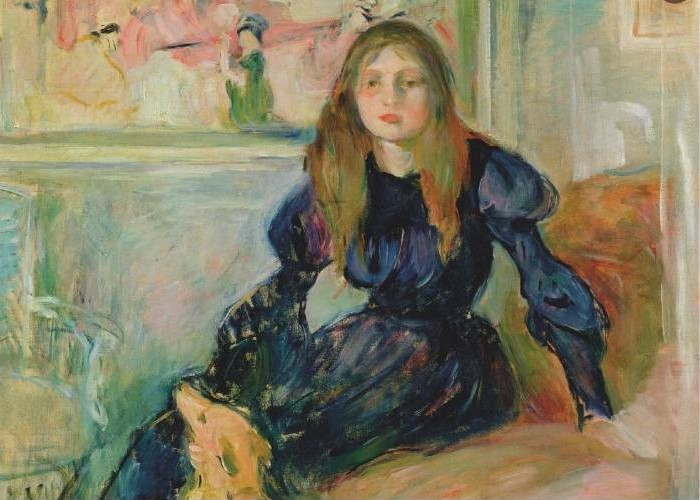
And they sewed it! Blue, crimped, with a stand-up collar, a slightly elongated waist, and a somewhat immodest skirt that revealed her slender legs; and to go with it, they bought red Czech glass beads and cherry-colored high-heeled shoes. Her hair, usually twisted into an ugly bun, was let down, and now it flowed like a wide night river over her shoulders.
2
My God, what a day it was, what a wonderful, amazing, indescribable day! The girl’s dark cheeks blushed quietly with unthinkable excitement, her dark eyes sparkled… She was all light and excitement—pure, boundless, and bottomless delight. This striking, simply incredible change was noticed not only by the teacher, but also by her classmates: they whispered, shrugged their shoulders, rolled their eyes, and shook their heads… But Anya kept her distance from everyone and did not communicate with anyone, absolutely no one. And not only because of her habit of keeping to herself, but also because she saw and noticed nothing and no one: all her feelings were filled with an amazing, unprecedented holiday…
Then came the long winter holidays, and after they were over, Anya appeared in class in her usual brown, unattractive uniform, in her usual dull, unremarkable appearance; time and the established stereotype in everyone’s minds replaced Anya’s strange festive image, and no one in the class even remembered her wonderful transformation. And everything went back to its usual routine.
3
Perhaps everything would have turned out in the future as the three women had dreamed, quiet and peaceful. Anya would have finished her studies, maybe gotten married, maybe had children, maybe… But it was not meant to be. Chance, absurdity, the wild unpredictability of life… If only we knew where to fall!
Don’t blame me for being banal: I just don’t know how to express my feelings, how to explain everything that happened next.
Books had always been a joy for Anya — they were an escape from her lonely and dull everyday life. What’s more, the best children’s library in town was right nearby, she didn’t even have to cross the street. So, starting in fifth grade, she was allowed to go alone once every two weeks to get new books — just one, can you imagine!
However, her grandmother was afraid of these independent trips to the library for a long time. She was convinced that the girl could get lost or — even worse — go missing. So Anya’s dress pocket, coat, and bag were filled with notes with her address, first and last name, and the key to the apartment was hung around her neck on a strong black cord, just in case. Anya couldn’t stand having that key around her neck! As soon as she crossed the threshold, she would take it off immediately and, in protest, start twirling it around her finger as if it were a propeller and she were a helicopter, and then she would run headlong into the library.
It became a tradition, a ritual, a constant joy. She would often wander among the shelves for a long time, enjoying the mysterious, mesmerizing silence of the vast reading room and the fantastic, unique scent of the library. She would approach familiar authors, say hello, touch the books, pick some up, leaf through them, peer at and listen to unfamiliar names and titles… And finally, she would choose! Then, in anticipation of happiness, she would rush home, immediately climb into a wide old armchair, and before starting to read, she would leaf through the pages for a long time, trying to imagine what awaited her.
Once, at the beginning of her ninth-grade year, she came across a wonderful trilogy by Yuri German. She didn’t read it – she devoured each new book in one gulp, living those days as if in a fog, with all her soul, with all her heart—with her entire being—moving into a different, courageous, uncompromising life…
Anechka suddenly matured completely and irrevocably, discovering her spiritual and emotional core. From that moment on, her dream of becoming a doctor took hold of her completely, becoming her life’s goal, her undivided and unquestionable meaning. She began to read everything she could find about doctors, diseases, the history of medicine, the fight against the plague and cholera… With boundless perseverance, she studied biology, chemistry, physics—everything that would enable her to enter medical school. Medical school, because from that moment on, no other profession was even considered. True, once her grandmother tried to dissuade Anya from this terrible, completely meaningless whim, but to her great surprise, she was rebuffed—gently, but with such adult categoricalness that she never even mentioned it again.
4
Anya continued living apart from everyone, alone, just as she had before. But now it was a detachment of a different nature—the deep concentration of a mature personality wholly absorbed in the achievement of a goal. The teachers just shook their heads in amazement, seeing such a striking change in the girl, which they could not understand how or why it had happened. She gradually became the pride of the class, but it was obvious that the change in her status did not bother Anya in the slightest. She had neither the time nor the desire to think about such insignificant nonsense. Perhaps that is why her classmates reacted quite calmly to such a change, and Anya had no enemies or ill-wishers in the class.
Two years of intense, all-consuming study flew by at an incredible, monstrous speed, and now only the entrance exams stood between her and her goal. Just that…
5
Admission to medical school was categorically out of the question for someone like Anya. Failure was guaranteed. No, of course, there were three exceptions: for a lot of money, through high connections, and, occasionally, in cases of exceptional, extraordinary abilities. But that’s just the way it was in Tsarist Russia, by the way!
Anechka’s family had no money or connections, and, as I already mentioned, Anechka, unfortunately, did not possess any exceptional gifts. Yes, she was very capable, hardworking, and persistent, but she was not a genius. However, she would probably have made an excellent doctor, the kind that practical medicine relies on, but…
Unfortunately for her, Anya grew up to be a typical introvert, an absolute introvert. She had no warrior qualities or any other qualities that would enable her to defend her rights fiercely and uncompromisingly, to fight and repel anyone who would dare to attack her — there was not a trace of such qualities, and there could not be. Because she had never had to defend and assert her dignity before. There was no reason to. So she had no experience whatsoever.
That is why Anya’s exam, which followed a well-rehearsed and repeatedly played-out scenario, ended as it was supposed to, by definition.
Damn physics! Most often, it was precisely this subject that the examiners used, with all sorts of ridicule and nitpicking, to fail the eager youth. However, in her case, they did it with mere play-acting.
There were two examiners: a bitter, fussy man of about fifty and a fairly young man, but already rapidly going bald, overweight, and sluggish. They worked together flawlessly, like a well-oiled machine. Anechka didn’t have time to open her mouth and start answering a question before the pair began talking loudly to each other about some pressing issues at the institute. But as soon as Anechka fell silent in embarrassment, a well-fed, lazy, relaxed voice asked:
“Forgot? Don’t know? Maybe you should move on to the next question?”
Anechka gathered herself and started to speak again… and the loud, friendly conversation immediately resumed. This happened several times until Anya was finally thrown off balance: tears welled up in her eyes, her lips trembled, and it became clear that the Jesuits’ goal had been partially achieved — she was about to burst into tears. Then the bitter man suddenly got up, went to the window, opened it wide, and began to look out into the institute courtyard. Anya, of course, sat silently waiting, while the examiner, having looked out the window, lit a cigarette and, blowing smoke into the room, asked loudly:
“So, are you going to answer, or what?”
Anechka wiped her eyes and concentrated with all her might… But she had not uttered ten words when an authoritative shout came from the window:
“What, haven’t you eaten today? I can’t hear you at all! Louder, please!”
Anechka couldn’t speak any louder. A nervous spasm clenched her throat, and she was unable to utter another word.
Seeing that his tactic had worked—finally and irrevocably—the bitter bastard threw away his cigarette, tore himself away from the windowsill, picked up Anichka’s exam book, wrote a “C” with a contemptuous expression, signed his name, and added a sloppy squiggle, saying:
“That’s it. You can go.” “Say thank you for the ‘three’,” he said, throwing it at Anya. And then the bullies went back to talking about their own business.
It was a complete failure. With such fierce competition, there was no way she could get into college with a “three.” Anechka cried bitterly until morning, left the house in the morning and wandered around until evening, then sat on her bed for a long time, staring blankly at the wall, rocking like a pendulum, until she fell back on her pillow from incredible physical and mental exhaustion and fell into a dead, deafening sleep.
6
Anechka did not go to her final exam, but a few days later, she got a job as a nurse in the city hospital, very close to her home. She began washing floors in the wards and corridors, cleaning toilets, taking out bedpans and chamber pots—doing all the dirtiest and most mindless work there was. She also enrolled in evening preparatory courses at the medical institute and studied diligently.
The local nurses—all women from the suburbs—at first, as usual, tried to bully her, but then, seeing her exceptional diligence and perseverance, her easygoing and kind nature, they even began to protect her. And her sister, the head nurse, with the support of everyone else, quickly dealt with a couple of real hags who were seriously picking on Anya, setting her up, and passing their work on to her.
7
Shortly before New Year’s Eve, something amazing and completely unbelievable happened: a handsome young man, shy and silent, suddenly began waiting for her after work. Anechka couldn’t even imagine where this gentleman had come from. Whatever the weather, he met her several times a week after work and then followed her home silently.
She was so curious that one day she allowed her mysterious admirer to approach her and speak to her; he turned out to be a paramedic, and the mystery was solved. However, she was still surprised by his appearance, so much so that she even agreed to go on a date with him several times. But Anya, who was utterly unable to communicate and was immersed in herself to an unimaginable depth, remained totally indifferent to him. He seemed completely uninteresting to her, and these wanderings took up too much of her time.
So they parted at her insistence, although for a long time afterward, when she remembered the young man, her cheeks would suddenly flush, a faint smile would appear on her lips, her heart would tremble softly… And she would feel strange. And if he had suddenly reappeared… But he did not.
8
The year flew by very quickly, almost uneventfully. Except for the unexpected courtship of a handsome paramedic… But otherwise, nothing —only work and study.
Anechka failed her exams again. She was only one point short.
Like a lunatic, seeing and hearing nothing, she dragged herself home, collapsed on the floor in the hallway, and burst into uncontrollable, violent hysterics. Her grandmother, seized with mortal terror, could barely dial the number for an ambulance.
She was given an injection, prescribed pills, and even given three days off work. Three days later, she went back to work at the hospital, her face swollen and trembling, her lips bitten, half-alive… People said she looked better in a coffin. Even the seasoned hospital staff were alarmed.
9
The next day, the head of the department—a smart, experienced man who had seen it all and whom everyone in the hospital called “Grandpa Petro” behind his back, called Anya into his office, sat her down, poured her some hot tea, and, careful not to frighten the poor girl anymore, began to talk to her:
“What, Anya, you didn’t get in? I know you’ve tried twice already. Don’t be so hard on yourself. If you can’t get in the front door, you have to go around the back. There are no hopeless situations. Try to put this idea of going to college aside for a while.
No, no, sit down, don’t rush, at least hear me out. Here’s what I suggest: my wife teaches at a medical school. I talked to her yesterday, and she’ll bring you all the textbooks, study guides, and everything you’ll need. Next year, you can try applying to their school instead of the institute. Well, you’ll get your secondary education first, it’s not a big deal, you’ll be close to your profession, and it’s better than waving a rag around—and then we’ll see. Agree?
Well, why are you silent? Oh, I almost forgot. I have more news for you. The housekeeper is leaving at the end of November to look after her grandson. I talked to the boss, and if you agree, you can take her place. You’ll have more time to study, and the work is easier.
Come on, don’t cry, don’t cry. Everything will work out, my girl, you’ll see, everything will work out.
10
Anechka was accepted at the school a year later. Her grandmother died just a few months before this happened. So she and her mother celebrated their little holiday together: they set the table, drank a little wine, cried on each other’s shoulders, and went to the last movie of the day.
Time went on. Anya began studying and working part-time at the hospital in the evenings. No matter how much her Grandpa Petro tried to dissuade her, she persisted, because she couldn’t imagine giving up the hospital, even temporarily, for school. Because studying at the school was only a concession to the insurmountable, ruthless circumstances, and she did not see her enrollment in any other way.
11
Those were three strange years. Anya was constantly haunted by a terrible feeling of mediocrity, transience, and compromise. This was especially true during her first year of school, when she did not really live, but merely existed in a state of constant, insatiable anticipation of the moment when she could try to fulfill her dream again. She even had several hysterical episodes that year, but they were not severe: they were quickly suppressed and did not seem to have any visible consequences.
Even the fact that by the end of her studies she was working as an actual nurse at her hospital did not bring her any pleasure or satisfaction. Her desire to become a doctor — and only a doctor — was so powerful, so all-consuming, that her other desires seemed unimaginably insignificant, receding not even to the background but to the third and even fourth planes.
12
She did not manage to get a red diploma, which would have provided her with some benefits, albeit ephemeral ones. Work, study, household chores, because her mother’s health was deteriorating… It didn’t work out. She worked at the city hospital for another year after college, spending entire evenings poring over textbooks. She felt terrible. Inside, something was constantly shaking with uncertainty and tension. She understood clearly that she needed rest, that she needed a break, that she needed to gather her strength, to calm down… But all this was only theoretical. In reality, she couldn’t stop. Her dream wouldn’t let her live, wouldn’t let her breathe, it ruled her destiny!
They couldn’t cure her.
13
Once again, as in her childhood, large pieces of paper with her address and surname are placed in her pockets, and the key to her apartment is hung around her neck on a black string. She hates the key, just as she did as a child, and takes it off at the first opportunity to spin it like a propeller.
She wanders aimlessly around the city all day, twirling the key on her finger and smiling. Sometimes she approaches someone and strikes up a conversation. She always asks if they are well and if they have a fever, and without waiting for an answer, she moves on.
She wanders around the city, smiling serenely and twirling her apartment key on a string around her finger, and no two-legged nastiness threatens her anymore.