Uncle Vasya worked as a switchman at a tiny railway station, and lived, as switchmen do, in a small house near the railroad tracks. Next to the house was a shed with all sorts of spare parts and tools needed to maintain the switch, and in the house lived his wife, Anastasia Nikitichna, who was indispensable for taking care of Uncle Vasya himself. There were also chickens, geese, and ducks living there, but they were kept in a chicken coop attached to the shed and had nothing to do with the switchman’s work. They were kept simply for food and to add variety to the dreary life of a switchman. All these animals were under the care of Anastasia Nikitichna, and none of them bothered her Vasya at all, as long as they were alive and running around the yard.
The area around the house was deserted and joyless, and the closest place where one could meet a living soul was the village cemetery. That was it.
But Uncle Vasya did not particularly mind the loneliness, because, first of all, he had long since grown accustomed to his situation, and secondly, there was nothing that he needed from people to make him miss them very much.
Everything would have been perfectly fine, but Uncle Vasya and Anastasia Nikitichna had no children and were not planning to have any, and this often caused sadness in their home and greatly soured the relationship of this still young couple. However, every living soul gets used to the circumstances of their life, even the sad ones. So Uncle Vasya and Anastasia Nikitichna also got used to their circumstances and even resigned themselves to them, but from time to time such grief and melancholy would fall upon the couple that a cold battle would begin between them, sometimes over something completely trivial, and sometimes even trivial things were unnecessary for that. It never came to a heated battle, that is, to blows, on either side, and it never went beyond abusive words and the throwing of heavy and light objects. But such times, with all their distinctive features, were not far off, and they themselves, especially Uncle Vasya, sensed this trouble. Here’s how it happened.
One day… It happened because of the livestock. The chicken coop was very old and had begun to fall apart a little. Anastasia Nikitichna nagged her husband every day: “When will you finally wake up, you lazy bum? Fix it, you good-for-nothing, your lazy hands will wither away.” Uncle Vasya endured this nagging, he endured it, but one day he couldn’t take it anymore. He rushed at Anastasia Nikitichna with his fists and beat her up quite badly. He beat her up so badly that she fell, poor thing, and then he tried to soak her with all kinds of herbs and gave her water to drink. Afterwards, he felt so ashamed that he swore to her and to himself that he would never raise his hands at her again, and it must be said that he kept his word. That’s right.
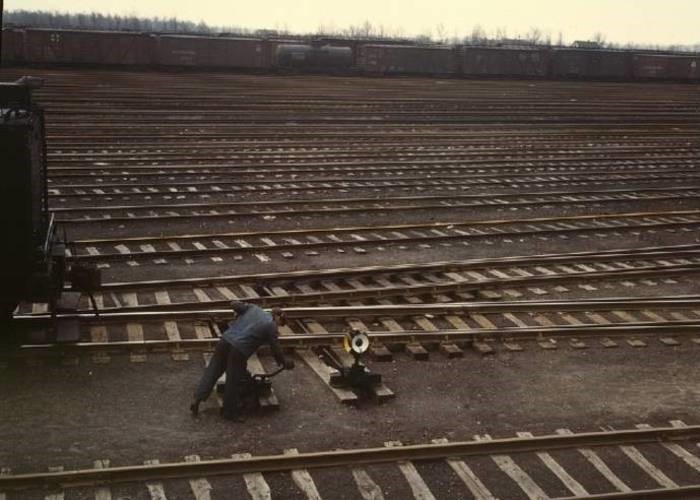
But the whistle on a steam locomotive was not invented solely for signaling purposes, as you know. And Uncle Vasya developed a strange habit for the same reason: as soon as he felt that a quarrel was about to break out and that his temper was about to boil over, he would rush off at full speed, dressed as he was, regardless of the weather, to the innocent track switch arrow, and moved it to where it wasn’t supposed to be. Then he would rush back, bang his fists on the table, and shout in a rage that countless innocent souls would perish because of that accursed woman’s tongue, and that he would kill himself after that. That’s right.
The very first time she saw such a thing, Anastasia Nikitichna threw herself at her husband’s feet, screamed in a voice not her own, and begged him for forgiveness, imploring him above all not to take the sin upon his soul, but to spare himself and the innocent souls.
So, the strange man, forgive me Lord, changed his mind and they both ran like mad toward the arrow, and Uncle Vasya reset it to the right position. And then, after this terrible experience, they threw themselves into each other’s arms, and immediately would start a feast, and drink bitter wine for the happy deliverance of innocent souls from a cruel and untimely death.
And so it became their custom: Uncle Vasya, biting his bit, would rush to move the track switch arrow, followed by Anastasia Nikitichna, who would fall at his feet, and then they would be completely reconciled and have their feast. That’s right.
I don’t know how long this went on, but the good people found out about the commotion and, as was their custom, reported on them. And an investigation began as soon as they did that. But the investigation didn’t turn up anything, of course. Uncle Vasya denied everything, and Anastasia Nikitichna didn’t give up her husband; she held her ground as best as she could. The commission decided to play it safe and stay away from the case; they found some kind of nervous disorder in Uncle Vasya and, just in case, fired him from his job. He should’ve been thankful that those terrible times were over, otherwise he would have ended up in a place not so far away, so fast that he wouldn’t have had time to squeak.
Well, the residents of the surrounding villages gossiped a little, but soon forgot about the switchman and his wife, especially since a new switchman had appeared, and people found the newcomer much more interesting to talk about. That’s right. Uncle Vasya moved with his wife to a distant place, got a job as a guard at a sugar warehouse, and he and Anastasia Nikitichna went on living there. But the melancholy, their old disease, followed them to the new place and settled in with them, attacking them just like before, so their quarrels never ended. Only now there was no peacemaker around, and when it came to minor scuffles on both sides, who knows what it could have led to—really, only God knows.
So what did Uncle Vasya, the former switchman, decide to do? He didn’t wait for things to come to a head between him and Anastasia Nikitichna. One day, he took all his switch equipment out of storage, which, when they had moved to a new place, he had somehow carried out of the shed with him, bought some discarded rails somewhere, and built his own track switch at the edge of the garden, near the forest. Well, well!
From that day on, as soon as the couple’s quarrel reached a boiling point, the former switchman would rush to his garden and switch the track switch that saved his marriage. And Anastasia Nikitichna began to indulge her husband in this, forgive me Lord, foolishness: she ran after him with all her might, threw herself at his feet and howled in a terrible voice, doing exactly what one should do in such a case. Then, as was customary, the matter ended with a stormy reconciliation and a feast, and the main toast, to the innocent souls who had escaped an untimely death, was invariably the first to be uttered, in accord with their custom. Such are the ways of the world.