I didn’t go into the light. There was no tunnel. There was only the feeling that the bulletproof vest that weighed a ton had finally been taken off me. A bulletproof vest of professionalism that no longer protects me.
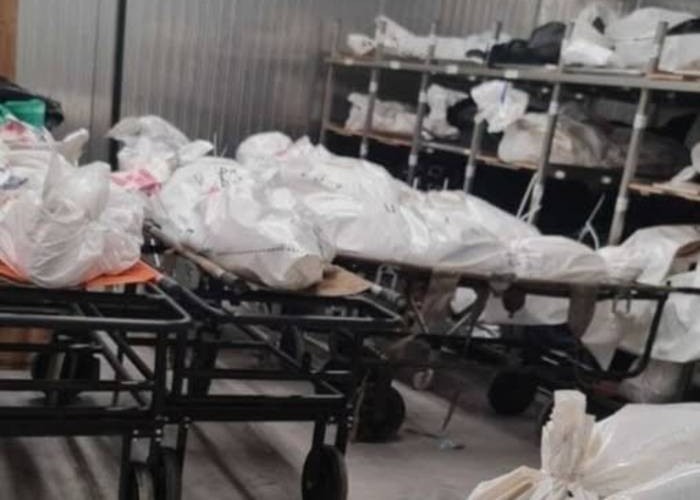
Now I’m standing here, by the wall of the hangar. I can see them—alive. They walk around in white protective suits, like astronauts who have landed on a dead planet. I hear the hum of refrigerators. I would recognize that sound anywhere. The dull, monotonous rumble of Thermo King generators. They work tirelessly to keep the cold from letting that smell out. But the smell is cunning. It passes through metal, through mask filters, through skin.
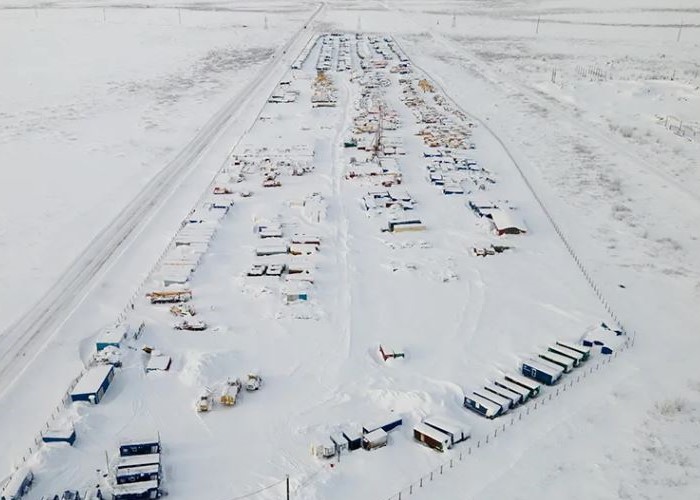
Welcome to Mahane Shura. The military rabbinate base. Until October 7, it was quiet here. Dead soldiers were brought here—one or two a year. With respect. In silence.
But then the world turned upside down.
I remember the first day. Trucks. Not military Hummers, but ordinary trucks, refrigerated trucks for supermarkets, trucks with chickens. They stood in line. Liquid flowed from them. Dark, greasy puddles remained on the asphalt. We sprinkled sand on them so we wouldn’t slip. Slipping on a human being is scary.
Do you think hell is fire? No. Hell is white bags. Thousands of white plastic bags piled up in containers.
I am a criminal investigator. My job is facts. Fingerprints, genetics, dental records. Until October 7, I believed that science could explain everything. That there is order in death. There is a body, a cause, a name. We give back names to those who have passed away. It is our duty.
We were put in charge of identification. We weren’t ready. No one was ready. There were stainless steel tables in the room. It was cold. The light from the lamps was sterile, merciless. We opened the bags.
Sometimes there was a person. Sometimes, a part of a person. Sometimes just charcoal. Small, doll-sized pieces of charcoal.
“Is that a child?” Yoni asked me on the first day. Yoni is a healthy man, a ZAKA volunteer, and a bakery owner.
I looked at the CT scan. The machine hummed behind the wall 24/7, overheating but never stopping. White spots glowed on the monitor. Bones.
“Yes,” I said. “The spine. See? He’s about five years old.”
We didn’t cry. You can’t cry there. Tears fog up your protective goggles, and if you take off your goggles, the smell will burn your eyes. The smell is sweetish, heavy, with a hint of iron and burnt rubber. We rubbed Vicks under our noses and chewed mint gum, but by lunchtime, our sandwiches tasted like death. The worst thing was not seeing the body. The worst thing was seeing the details. The painted nail. The butterfly tattoo. A wedding ring on a finger that lay separately from the hand. It knocked the wind out of my lungs. It was someone’s love, someone’s mother, someone’s daughter, who just yesterday was choosing nail polish. And today I’m trying to match DNA so she can be buried.
We worked in pairs: a forensic scientist and a volunteer. We took all the samples we could: nails, deep muscle, saliva, if by some miracle we could.
But when all that was left was ashes and bone fragments, I called them. The pathologists.
They worked in a separate room. We, the forensic scientists, stood nearby, behind glass, to ensure protocol was followed. And we heard it. The screech of a saw cutting through human bone.
They cut open the femur or a vertebra to get to the bone marrow—the last place where DNA could have survived the fire. I, a man of science, watched as they sawed through the remains to extract that tiny, gray piece of truth. And I understood: this is the limit of my profession. This is what they did to a human being.
I would come home late at night. I would take off my clothes in the hallway and put them in a bag. I would wash myself with boiling water. I would scrub my skin with a washcloth until it was red and bleeding. But the smell wasn’t on my skin. It was inside my nose and throat.
My wife, Anat, tried to hug me. I pulled away. I felt contagious. As if death were a virus, and I could pass it on to her and the children.
“What’s wrong, Dani?” she asked quietly.
“We’re working,” I replied.
You ask when I broke down? Not when I saw the headless baby. The professional in me put up a block: “This is biomaterial. Work.”
I broke down later.
A week passed, maybe two. The hardest work was in full swing. We were literally sifting through ashes looking for teeth, because there was nothing else left.
I went home to get at least three hours of sleep. I turned on the news.
I thought the world was crying with us. I thought the world was in horror. But on the screen I saw London. Paris. New York. Crowds of people. Thousands.
They were carrying placards. They didn’t say “Our condolences.” They said “Stop the genocide,” “Freedom for Palestine,” “Resistance is justified.”
I looked at the clean, beautiful faces of the students, activists, human rights defenders. They shouted into megaphones. They smiled. And under my fingernails, despite my gloves, there was still the ingrained soot from the family in Kfar Aza.
At that moment, something inside me snapped.
There, in Shura, we breathed death to prove that these people had lived. We collected evidence of absolute, biblical evil. And the world told us, “You are lying. And if you are not lying, then you deserve it.”
On the internet, they wrote that we burned our own children. That there was no rape.
I wanted to grab those Harvard students by the scruff of their necks and drag them to Shura. To Sector 4. I wanted to shove their noses into that bag where a woman lay with wire on her hands and her legs spread apart, her pelvis shattered from the violence before she was shot in the face. I wanted to ask them, “Is this resistance? Is this a fight for freedom?”
I saw how the world that swore “Never again” suddenly said, “Well, it depends on the context.” It turned out that Jews could be burned if you had the right slogan. It turned out that if the victim was Jewish, it was his own fault. He was an “occupier” in his own home, in his own bed, at a music festival.
This broke me more than the sight of the bodies. The betrayal of the world. The loneliness. We were picking up the pieces of our children with tweezers, and the world called us murderers.
Post-trauma doesn’t come right away. It creeps up on you.
First, I lost sleep. I closed my eyes and saw flashes: faces, wounds, bags. I heard the sound of lightning. Zzzzz. Opened. Zzzzz. Closed. That sound became louder than my children’s voices. And then the grinding began.
Then came the smells. I went to the park with my family on Independence Day. Someone was grilling meat. The smell of roasted flesh. I threw up right on the lawn. I fell to my knees, covering my head with my hands, screaming, “No, don’t burn them!” People were watching. Anat was crying. I realized that I was no longer here. I was still there, in the container.
I went to the doctor. The wait was three months.
“We’re overloaded,” said the tired girl at the reception desk. “Everyone is like that now. Wait.”
Work through it? How could I work through what I saw, a family tied together with wire and burned alive? How could I work through what I heard, the screech of the saw? This isn’t “trauma.” This is knowledge. Knowledge that humans are beasts. And that the world approves of these beasts.
I stopped sleeping. I looked at my children and saw them dead. I stroked my daughter’s head and felt her skull under my fingers. I became dangerous to them.
That day, I opened the news again. Women from the UN said there was no evidence of violence. No evidence. I remembered the body of the girl in room 3042. Her torn underwear. Her eyes, open, frozen in a silent scream, full of such horror that no movie could ever portray. “No evidence.”
Something clicked inside me. Like a burnt-out light bulb.
I realized that I couldn’t live in a world where evil was called good. Where murderers were applauded in the streets, and victims were accused of genocide for daring to survive and fight back.
I wrote a note. A short one.
“I love you. But I can’t turn off this smell. I’m sorry I’m weak. The world has gone mad, and I’m getting off at this stop.”
I went to the forest. Where it’s quiet. Where it smells like pine trees, not death. It wasn’t scary. It was upsetting. Upsetting for all of us.
Now I’m here. A shadow in Beit Shura.
I see my colleagues. Their hands are shaking, just like mine used to. I see reservists returning from Gaza. Their eyes are empty—the “two-thousand-yard stare.” They saw what I saw. They saw the tunnels where our children were held. They saw houses filled with weapons and Mein Kampf in children’s rooms.
And then they come home, open the internet, and read that they are war criminals. That they are committing genocide.
You there, in Europe, in America. You who wear keffiyehs instead of scarves. Do you even understand what you have done?
You didn’t just support terror. You killed the faith in humanity of those who raked through this hell with their bare hands.
You killed me. Not a bullet, not a rocket. Your indifference and your hypocrisy killed me. Your “Yes, but…”.
Listen to me. I’m dead, I have nothing to lose. Evil does not stop at borders. What we saw in Shura is what they want to do to you. To every “infidel.” With everyone who lives freely.
We are the shield. We took the blow. We are dying from bullets and from anguish, from our hearts that are unable to bear the pain.
And you stand in the squares and spit on our backs.
Look in the mirror. Who do you see there? Because I, looking from here, from the darkness of Beit Shura, see your darkness approaching you. And when it comes for you—and it will come—there will be no one to protect you. We are finished in the corridors of Beit Shura, trying to prove to you that we are human too.
Silence. Only the hum of refrigerators. And the smell. The smell of the truth you refused to know.