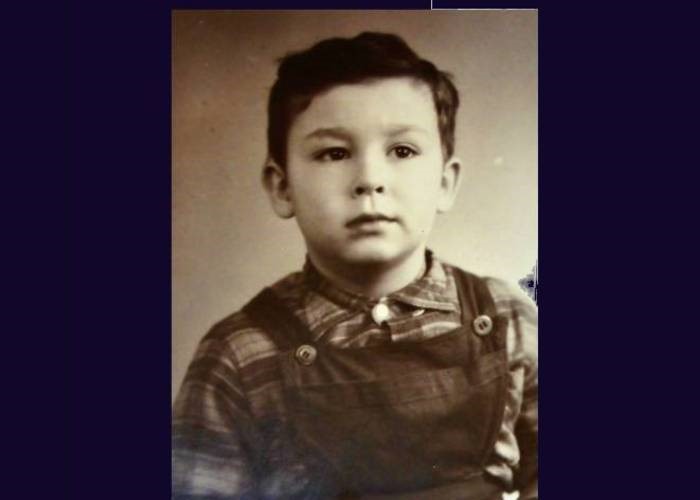
One day, I thought I’d lost him.
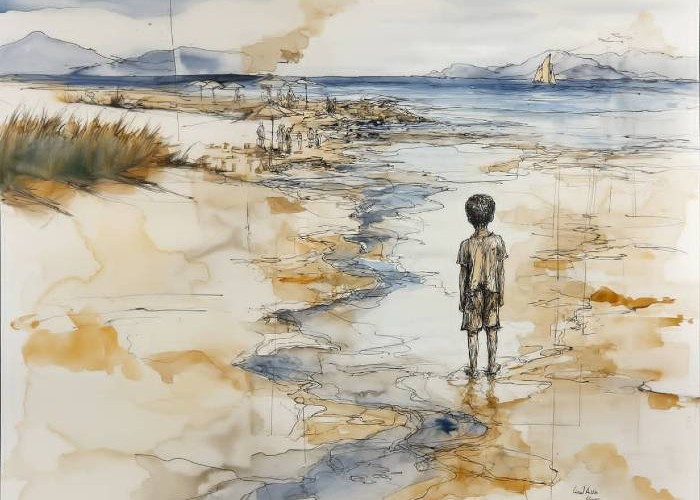
We were walking along the tide line, the Kid and I. He wouldn’t go into the water—he didn’t trust the waves, or really any force that couldn’t be reasoned with. I asked him to wait while I scooped up a bucket of clean seawater to make the shells look brighter, prettier. I turned back—and he was gone.
The beach was a blur of bright-colored umbrellas and human voices. The sun was so intense that it pierced through even my dark glasses. Panic gripped me—an old, childhood fear suddenly revived. I was five again, lost on the noisy Nevsky Prospect, dazzled by the flashing lights of shop windows, just like the sunlight now, burning in Netanya.
That existential dread—of being lost or losing someone—never really left me. In my youth, it softened, of course. Youth stretches out endlessly, and life back then seemed like a succession of improbable adventures, the kind you can barely recount now without laughing. All that remains is a barely perceptible scent of those years—of their warmth, joy, and a kind of giddy lightness. But we’re no longer there. We’re in the future we used to imagine.
“I don’t want the future,” the Kid once told me, and burst into tears.
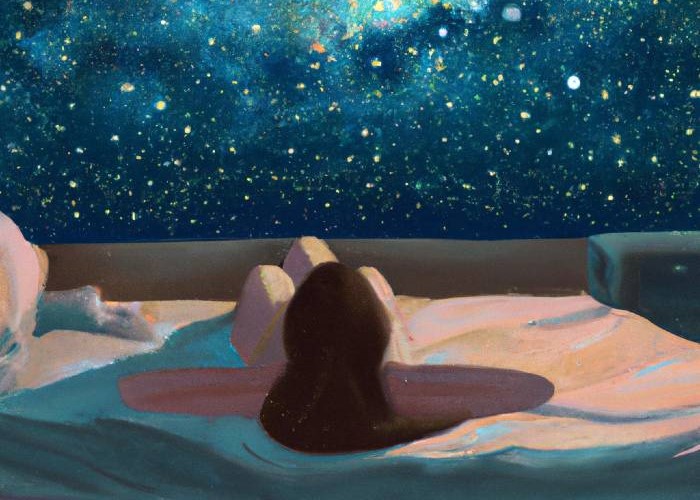
We had been flipping through a picture book filled with shimmering starships sailing through cosmic emptiness.
The idea of the future fascinated him—but also scared him, as all uncertain things do.
“Will you be there in the 22nd century?” he asked.
“No,” I said.
“What about Mom and Dad?”
I didn’t answer, but he understood.
“So I’ll be completely alone?”
“Of course not. You’ll have your own family, your own children…”
“Children??”
The Kid considered the idea of children with the same skepticism our cat Kasya reserved for them—Kasya, who dove under the bed at the first sight of toddlers, rightly expecting them to wreak chaos.
“Fine,” he finally said after a pause, “but only one. A girl.”
We were sitting at a café table beneath a large tree whose name I never learned. Every now and then, ripe fruit of some unknown species would fall with a dull thud. I hadn’t memorized all the trees and flowers of this country. He was still curious, though, examining each leaf like it held a secret.
People wandered past us, slow and heat-burdened. A soldier with a rifle slung over his shoulder was gently scolding his daughter, who looked about five years old. My boy observed the scene with great interest.
“You have no boundaries,” the soldier told the girl. But while saying this he was beaming. They both were. He owned that scene, it was his, like the girl was his daughter. The sun shone for them. That was happiness.
Later, at home, the Kid brought me a map of Belgium. “Let’s sail to Ostend,” he said.
He had fallen in love with my photos of Bruges and Ostend. So we “sailed.” The wind was sharp and icy; it bent the ship’s mast. Waves crashed over the bow.
“We’re going down!” he cried. We saved the passengers—Bear and Rat. Naturally, they survived. We reached the cold shores of Ostend, which Gogol had once adored. He used to bathe in its icy waters as part of prescribed cure. For what, I’ve forgotten to ask the locals. Melancholy, probably.
In the thick of an Israeli summer, the Kid and I dreamed of Ostend’s wind. Of white dunes like the ones in Sestroretsk—not that he remembered them, but he studied the photos and always knew exactly which album to pull from the shelf.
Sometimes he amazed me with his commitment to clarity. He knew, since birth it seemed, what he wanted and what he didn’t—and moving him from that position was almost impossible. Sometimes he would go quiet. His eyes drifted somewhere far away. He wouldn’t answer questions. Then, all of a sudden, he’d shake it off and snap back to reality.
That strange summer, I learned to look at the world through a child’s eyes. To observe more than analyze. To wonder more than protest. To resist being swallowed whole by fear. I learned to notice the shape of a plane tree’s leaf, the curve of a shell you could press to your ear (“Listen — you can hear the sea waves”), to study insects under a microscope and trace the silhouettes of continents on the globus.
The intensity of early life experiences — dulled over the years — had begun to return, in ripples, like incoming tides. The world would contract to the tiny café table beneath the tree and then suddenly expand to encompass the whole universe. And I would find myself again, in the streets of familiar cities or new ones—Jerusalem, New York, Helsinki, Stockholm, Kraków, Vienna…and Petersburg, always Petersburg.
I was learning to observe. And, sometimes, disappear into myself. I was learning to be the Kid. It helped—especially on mornings when we stepped out of the bomb shelter in the basement of our apartment block and the air was still cool, still clean, and the shattered world felt, for a brief moment, washed and new.
…That day on the beach, I ran up and down the shoreline, frantic. And then, finally, I returned to our umbrella and folding chair—and there he was. Sitting on the mat, calm as ever. He hadn’t wanted to go into the water, so he’d just come back on his own.
It had been his decision.
———————————————
The original, in Russian, was published in «Когда цветет джакаранда», a collection of short stories by Alla Borisova (second edition).