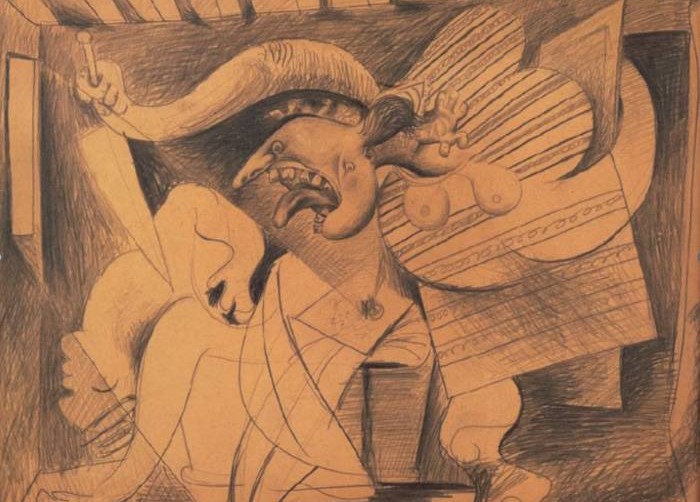
This ferocious drawing was created during a traumatic period in Picasso’s life. The two figures in the drawing are meant to represent –Marie-Therese Walter (the victim) and Olga Khokhlova (the assailant).
Violence touches or impregnates numerous spheres of human life. It can be direct or indirect, obvious or veiled, impulsive or artificial – squeezed through consciousness, spontaneous or calculative. It can be physical, emotional, or intellectual, in the present or future tense – menacing or condemning. It can belong to the spheres of international, social, and personal relations. It can be vengefully hot or indifferently masked – “polished” by justice and law. It can be made matter-of-factly through the red flowers of war. For human beings to become violent is as natural as to sweat or to spit.
Picasso is dedicated to the analysis of human violence (not because of “love” for it, for sure, but because of his horror and disgust) – either as an actual reality or its determinants and consequences. He depicted it in a record number of paintings, sculptures, and drawings. But “The Murder” is one of the most horrifying works among his impressive number of “violent art” creations. Do his exceptional visual analytic abilities of bringing together raw violence with stylistic “laces” around make his representation of violence in his art less violent? Or does it make them even more violent when the depiction of open violence challenges the viewers’ perception with endless elaborations, as is the case in “The Murder”?
Look at the murderer’s head-face, this ugly ripened fruit of hatred. Here, as in many of Picasso’s works, we have a stylistic “fight” between profiles and a frontal view of the protagonist’s face (presented in the act of murder). Are we seeing the assailant’s face in profile or fully frontal? It’s actually… both. Why does Picasso do it? Probably, to emphasize the intensity of hate he is depicting, hate that feeds and sustains the act of murdering. Hateful emotion psychologically distorts not only the soul of the hater but her face and body. We see the impossible – that the murderer’s right profile jumps to her left profile, and this monstrous combination creates an artificial, combined side of the murderer’s full or frontal face! We are looking at the twisted configuration of a clash between two profiles, creating a pseudo-frontal view of a face made up of two profiles. It is as if the intensity of hatred is so overwhelming that the right profile (together with the left one) creates a monstrous – predatory face ready to swallow the victim. Picasso here creates a monstrous amalgamation of the murderer’s facial expressions.
At first, the right (unseen to us) profile of the murderess violently “attacking” the left profile of her own face – her right eye on her head-face “jumping at her left profile side” follow the outburst of her violent energy, instigating her right arm-hand to strike at her victim with a giant blade-knife. The murderer’s right eye and right nostril, following the inhuman intensity of her destructive passion, now all appear on the left side of her profile. Murderously intense hate creates fragmentation in both – the soul and the body of the hater – here, the disproportionally enlarged right arm with a giant knife. It is as if the right and left profiles create a monstrous artificial pseudo-frontal face with two eyes and two incredible jawbones. The right nostril of the murderess has seized a spot on the left side of her nose, near the left nostril, while her right, her furious eye, has pressed down her left eye, which has lost all vitality. By this aggressive transformation, the left profile is transformed into a frontal view of the face, where the nose and the jaw are now transformed into two jaws with an exaggeratedly opened mouth filled with enlarged predatory teeth, along with a protruding tongue – the face of a monstrous creature is more horrifying than the “physiognomy” of a Tyrannosaurus. This seeming instantaneous transformation of a human being into a monstrous predator as a murder machine is, it seems, Picasso’s point about the inevitability of the face and body of a murderer being distorted and violated by her belligerence.
What can be the semantic justification for the artist to produce all these “miraculous” and horrifying transformations when his aesthetic intuitive “reasoning” goes together with his dedication to a psychological truth? – He makes his visual images communicate it: the tongue in a position of vomiting became a metaphor of a predatory posture, not just as a victory over the enemy but as a destructive consumption. Picasso forces us, the viewers, to look at violent feelings and behavior not just as a transfiguration of human beings but as an anthropological perversion. Picasso emphasizes that domination and manipulation of the world is the criminal destruction and consumption of the world and life. We enslave other people and the world in order to appropriate and survive on it – this is the basic problem, and not the fact that we want and need to survive. Greed and destructive over-consumption are just the beginning of our attack on the world, personified by the assailant in “The Murder”.
According to Picasso, the act of vomiting out our hate on the victim and the victim’s expulsion from humanity is the very basis of violence as a crime. Vomiting another human being out of life for the sake of our egotistical goals seems to be the main focus of Picasso’s drawing, its basic metaphor. Reducing any object to a means for achieving our plans and needs is a primordial violence against human beings – that’s what we learn from the face of the murderess in Picasso’s “The Murder”.
It seems like the attack is taking place in a bedroom or a bathroom where the victim was resting in bed or washing in the bathtub. We see the assailant’s left arm is grasping and keeping behind her back what looks like one of Picasso’s paintings, which she probably just stole from her victim or the painter himself.
Picasso’s ambition to depict the intensity of the predatory (consumptive) nature of human hate, creating the fragmentation of the human body, is astoundingly shocking. In a way, his “The Murder/Le Meurtre” is an incredible and daring experiment, a kind of brainstorming. And Picasso’s unbelievable achievement here suggests that human talent as such is ahead of our everyday misery of choosing obedience over freedom. Human creativity is far ahead of human calculations of cowardly, predatory survival.