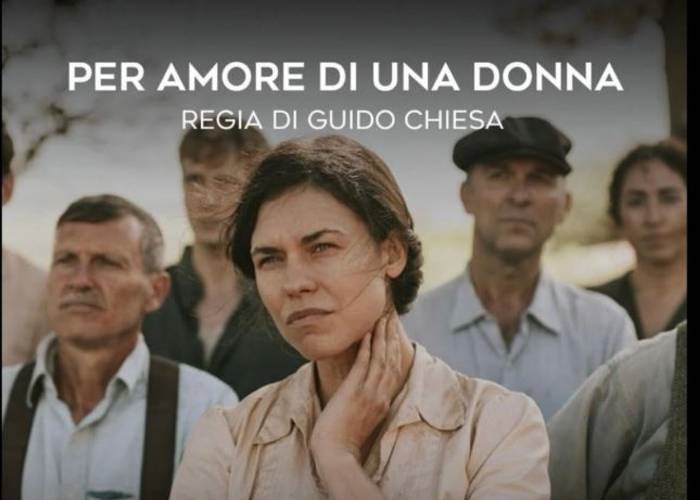
“For the Love of a Woman”
A film by Guido Chiesa
Based on a novel by Meir Shalev
It’s been a while since I saw a truly great film—the kind that makes a 20-minute subway trip to West 76th St. feel not just justified, but necessary. I bring up the subway not only because New York City’s system is notoriously easy to hate, but because a round-trip on it serves as a surprisingly effective yardstick for the value of what you’ve traveled to see. If the film stays with you despite the screech of the brakes, it’s done something right.
All of which is a roundabout way of saying: I went to see For the Love of a Woman, an Italian-Israeli co-production. The film, directed by the Italian filmmaker Guido Chiesa, is based on a novel by the celebrated Israeli writer Meir Shalev. The book is titled The Loves of Judithh, and having started it after seeing the film, I was struck by a significant divergence: one of the two plotlines that makes the movie so riveting does not appear in the novel at all. And that’s no small thing, because Shalev’s prose possesses the kind of magic only literature can conjure—incantatory rhythms, fantastical imagery that nods to García Márquez and Gogol alike. In essence, the book has one narrative thread; the film has two.
The second thread—added by Chiesa and serving as the movie’s structural backbone—is set in the mid-1970s. It follows Esther, a grieving American woman in her thirties, who receives a letter hinting at a family secret tied to her origins. Compelled by its contents, she travels to Israel in search of a woman who lived in Palestine during the 1930s. And it is there that the two timelines converge: the contemporary search and the historical past intercut, each scene lasting roughly eight to ten minutes, alternating with rhythmic precision.
What struck me most about For the Love of a Woman was not merely the superb acting, the luminous cinematography, or the way the two narratives first diverge and then intertwine—though all of that is impressive. What truly resonated, and feels especially vital for our times, is how the 1930s storyline portrays its Jewish pioneers as people living off and working the land. We encounter this timeline in reverse, so to speak; we don’t learn the fate of its protagonist until the very end. Initially, she appears as a young woman—peculiar, deaf in one ear—arriving at a Jewish village in the Yishuv to work as a milkmaid. She asks to sleep in the cowshed, admits she doesn’t know how to milk a cow, and her new boss—whose house shares a wall with her shed—gives her a milking lesson.
I won’t retell the plot further, but I mention this to underscore a key point: the film shows the pioneers of the 1930s as laborers, builders, cowhands in the most literal sense. They are not part of a kibbutz; they are villagers, and they are building their village with their own hands. All are immigrants from Europe—the four main characters come from Ukraine, Romania, Germany, and another country I can’t recall—and all come from educated families. Yet here they are, choosing to live rough, to work the soil. Religion is entirely absent from the film; not even a whisper. (And as far as I know, this reflects reality, not just this particular film.) The sole political nod comes in the contemporary storyline, when the male lead tells his American guest—while showing her the cowshed where he was born—that its inhabitants came from different parts of Europe, adding simply: “Centuries of persecution.” That’s it. That’s all we hear.
The heart of the film is Judith—the woman who lives among the cows she tends—and her loves, as the novel’s title announces. After the screening, in response to someone from the audience saying that the story could have been set anywhere, even rural Italy, the director agreed but noted that it could have been set anywhere except for one crucial difference: in 1930s rural Italy, women were far from free from patriarchal constraints, while Judith is utterly, completely free. It’s worth adding that Chiesa is Italian—not Jewish Italian, just Italian—and though he is acutely aware of the political complexities surrounding Israel today, he deliberately steers clear of them in this film. The result is a work that feels intimate, human, and timeless.
In the end, For the Love of a Woman is not a film to miss. It will be showing at the Quad Cinema on West 13th Street for just three days: June 26, 27, and 28. Do yourself a favor—brave the subway and go see it.